What is Custom Indexing?
Published: Jun 01, 2026
Historically, self-directed investors had two options for accessing diversified portfolio growth: buy an ETF or mutual fund that tracks a broad-market index, or build your own portfolio—stock by stock.
The first gives you diversification, but no control over what's inside, and management fees deducted from your returns. The second gives you full control of what you own, but leaves you to research, buy, and manage every position yourself when the market moves.
So, what is Custom Indexing?
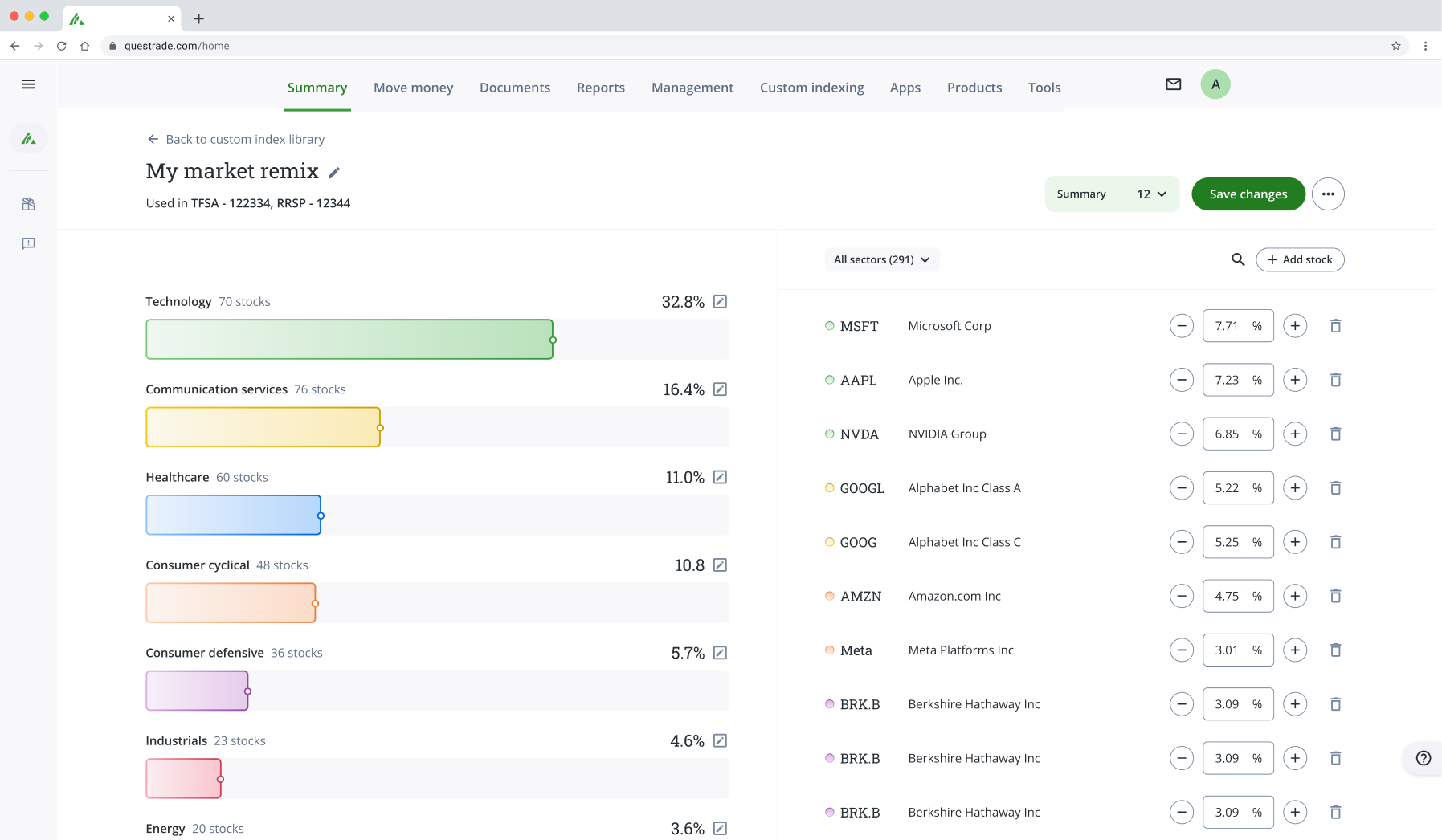
Custom Indexing is a new self-directed investing product that lets you build, own, and manage a custom index—giving you broad-market diversification in just a few clicks. You have the control to shape every stock and sector inside it—and one-click rebalancing to keep your index on target as the market moves.
What makes Custom Indexing different than investing in an ETF or mutual fund?
Control what you own: When you buy an ETF or mutual fund, you don’t actually own the stocks inside of it. You own a piece of the fund that holds those assets—and get no say in what the fund buys or sells. This also affects things like your voting rights and what dividends you receive.
Custom Indexing works differently. You own the individual stocks that make up the index. You get the same broad-market exposure, but with a say in what you actually own—by stock or by sector.
No management fees: Both ETFs and mutual funds charge an ongoing management fee, a percentage of your assets deducted every year, regardless of performance. Mutual funds in particular can run 2% or more annually.
Questrade charges no platform management fee on Custom Indexing, and no commissions on stock or ETF trades. If you hold ETFs in your Custom Index, though, the fund may still charge MER fees and FX fees may apply depending on what currency you purchase securities with.
What makes Custom Indexing different than direct indexing?
While they both give you ownership of individual stocks inside a bigger index, Custom Indexing gives you an actual say in what those stocks are. Direct Indexing, on the other hand, forces you to accept the choices of either a fund manager or a platform’s algorithm.
Often, traders pair Direct Indexing with tax-loss harvesting: the practice of selling individual stocks at a loss to offset taxable gains elsewhere in your portfolio, which only works in non-registered accounts where capital gains are taxable. This is possible in Custom Indexing, too, but isn’t built in.
Custom Indexing takes the same core idea of direct ownership, but works differently in two ways:
Full control:
Direct indexing is most often offered as a service where a platform's algorithm, or an advisor, builds, rebalances, and harvests tax losses on your behalf. Custom Indexing is self-directed: you build your index, you decide when to rebalance, and you click to do it.
Built for the accounts you already use:
Because Custom Indexing isn't built around automated tax-loss harvesting, it works across the most popular registered accounts—TFSA, RRSP, FHSA—as well as non-registered cash accounts.
What makes Custom Indexing more efficient than stock picking?
Start from a template
Custom Indexing skips the blank page of not knowing where to start your investing research: pick a template that reflects the broad-market or thematic exposure you want, then customize from there. You’ll be up and running in a few minutes.
Edit your index anytime
Your view of the market changes, and your index can too. Add a stock, remove one, or shift the weight of a sector, anytime. With up to 600 securities in a single index, that means hundreds of positions moving together in one click—hundreds of trades placed, all with no trading commissions.
Automatically reinvest your dividends
When the companies in your index pay dividends, those payments can be automatically reinvested back into your Custom Indexing account according to the ratio you set for the index, so dividend payments compound alongside your contributions.
How does it work?
Custom Indexing currently supports any fractional-eligible stock or ETF on the Questrade platform—a universe of more than 16,000 securities.
That covers the constituents of most broad-market US indices, and lets you customize down to the individual ticker without needing a full share to do it.
Open a Custom Indexing account: Available as a TFSA, RRSP, FHSA, or cash account.
Build your index: Start from scratch, a template, or build with AI. Pick a broad-market or community-contributed thematic template as your starting point, then customize. Adjust your exposure by stock or by sector, add stocks that are missing, remove the ones you don't want.
Buy in: Fund your Custom Indexing account, starting from as little as $10, and apply them toward your new index.
Correct drift in seconds: You can rebalance your portfolio anytime and your account has built-in alerts to help you monitor it. When your portfolio drifts more than 10% from your targets, you’ll get a notification. Just log in, review the rebalance summary and confirm in one click.
Who is Custom Indexing best for?
The hands-on investor: If you want your portfolio to reflect how you see the market, Custom Indexing lets you act on that view with the diversification of an index as the foundation. You spend your time on the decisions that matter to you, not on executing hundreds of individual trades to keep your portfolio in line.
The ETF investor: If you currently hold broad-market ETFs and have found yourself wishing you could exclude a company, overweight a sector, or shape the index around your own thinking, Custom Indexing gives you that control without giving up the diversified exposure you bought the ETF for in the first place—and without the management fee.
In summary
Custom Indexing gives self-directed investors a way to own a broad market index the way they want to own it: customizable by stock or sector, no management fees, and built to make ongoing maintenance a few clicks rather than a weekend project.
Ready to build an index that's actually yours? Open a Custom Indexing account in minutes, as a TFSA, RRSP, FHSA, or cash account.