INVESTING BASICS
Short Selling Explained (Canada): How It Works, Costs, Risks, and Key Terms
Learn how short selling works in Canada—rules, fees, and squeeze risks—plus checklists you may need to manage risk in your portfolio.
Short selling is a trading practice observed in Canadian markets where investors sell borrowed shares with the intention of repurchasing them later, ideally at a lower price. This approach involves specific costs, such as borrowing fees and margin interest, and carries significant risks, including potential losses that exceed the initial investment. Understanding the mechanics, costs, and regulatory context could help provide clarity on how short selling functions in Canada.
Disclaimer: This content is for educational purposes only and does not constitute financial, investment, or individual advice or recommendations.
Why Investors May Learn Short Selling
Short selling is often used by investors as a tool to manage portfolio exposure and access market opportunities beyond conventional stock buying. Common reasons for engaging in short selling include:
- Hedging against downside risk.
- Taking a negative view of a company’s valuation or fundamentals.
- Executing pair trades or market-neutral strategies.
- Reducing exposure without needing to sell long-term holdings in some cases.
Short selling generally involves more risk than buying stocks. Details like trade execution, regulatory rules, and margin requirements could have a significant impact on potential losses. In Canada, understanding how short selling works—including borrowing fees, interest costs, and risk controls—could help clarify the risks involved.
Short Selling 101: The Mechanics
Borrow → Sell → Buy Back (The Simple Flow)
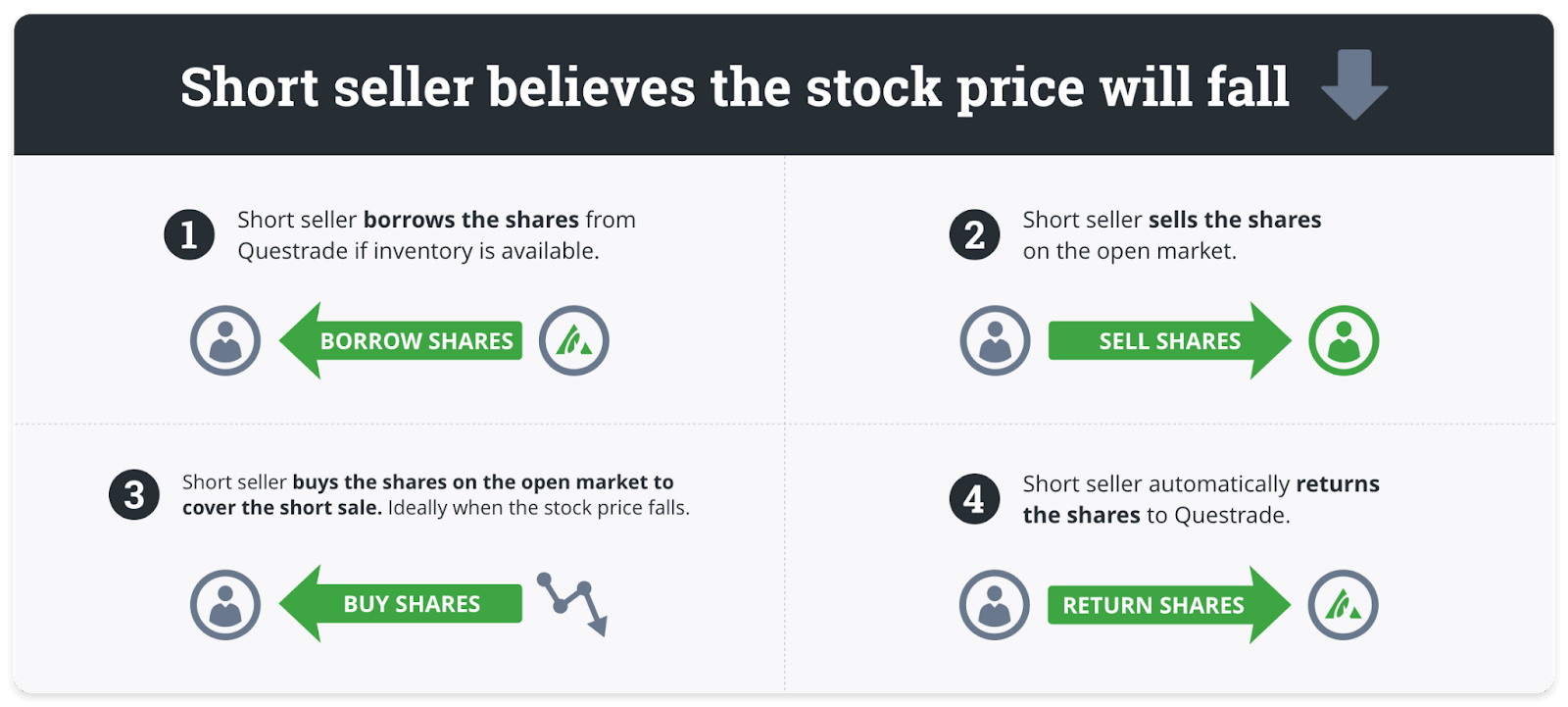
Short selling works in three main steps. Shares are first borrowed from a broker, which might get them from another client, an institution, or its own inventory. The borrowed shares are then sold on the market. Later, the shares are bought back, or “covered,” and returned to the lender.
The profit or loss from this process depends on the share price movement. If the price declines, the position generates a profit; if the price rises, a loss occurs. Because there is no upper limit on how high a stock price could rise, potential losses are theoretically unlimited. To manage this risk, brokers require collateral, often in the form of cash or other securities, and short selling is typically executed within a margin account, which sets minimum account equity requirements.
What Happens Behind the Scenes (Locates, Margin, and Recalls)
Before a short sale, the broker must check that the shares are available, a process called a “locate.” Availability could change quickly—shares that could be borrowed today might not be available tomorrow. Sometimes, the lender might ask for the shares back, called a “recall,” which requires the short seller to buy back the shares immediately, no matter the price.
Some shares are classified as “hard-to-borrow,” meaning supply is limited, and borrowing costs could increase sharply. These factors, combined with margin requirements, highlight that short selling is not only a tactical choice but also a practice that requires careful attention to execution, availability, and associated costs.
Canadian Rules You Must Know (UMIR/CIRO)
The Core UMIR/CIRO Framework
The Universal Market Integrity Rules (UMIR) are trading rules in Canadian marketplaces, enforced by the Canadian Investment Regulatory Organization (CIRO). They exist to protect market integrity, ensure transparency, and maintain proper settlement practices.
Key themes include:
- Transparency: Orders must be marked correctly to show whether they are short sales.
- Market integrity: Certain restrictions apply during rapid price declines or unusual market activity.
- Settlement discipline: Trades must settle on time, and brokers monitor obligations.
Even though brokers route trades and enforce rules, investors still have responsibilities. Short selling is not simply clicking “sell”—it requires compliance with order marking, borrowing or having access to shares, and observing rules that might activate during fast market drops.
Typical compliance points include:
- Correctly marking orders.
- Ensuring the ability to borrow shares.
- Understanding restrictions during rapid declines.
Awareness of these rules helps avoid regulatory issues and unexpected costs.
Order Marking: Short Sale vs. Short-Marking-Exempt
Order marking identifies the type of trade being executed. A short sale mark is used when selling shares that are not owned. A short-marking-exempt (SME) designation applies mainly to market makers or specific liquidity providers, not normal retail traders.
Correct marking helps support transparency and regulatory compliance. Trades that are not marked appropriately might lead to regulatory attention or broker intervention. Since retail traders generally do not qualify for SME status, most short sales are typically marked as standard short sales.
Reasonable Expectation to Settle and Failed Trades
A key UMIR principle is that before a short sale, there must be a reasonable expectation that the trade could settle. Failures could occur if shares become unavailable during corporate actions, recalls, or changes in hard-to-borrow-supply.
When settlement fails, brokers might trigger a forced buy-in, impose trading restrictions, and charge additional costs. Understanding these requirements helps manage the operational and financial risks associated with short selling in Canadian markets.
What It Really Costs to Be Short
The Obvious Cost
Short selling comes with a range of upfront costs. One of the most important is the borrowing fee (also called a stock loan fee), which could vary widely depending on the stock. Shares of large, liquid companies usually have lower borrowing costs, while hard-to-borrow stocks could be much more expensive. These fees are typically quoted as an annual percentage of the stock’s value.
There are also regular trading costs to consider. These may include broker commissions, the spread between buying and selling prices, and platform or routing fees. For Canadian investors shorting U.S. stocks, currency conversion could add another layer of cost, as CAD/USD exchange spreads may apply. Together, these expenses could have a meaningful impact on the overall result of a short position.
Costs that are Often Overlooked
Some costs of short selling are less obvious but could still have a big impact. If a stock pays a dividend while it is being shorted, the short seller must pay that dividend (cash-in-lieu) to the lender. Corporate actions, such as stock splits, spin-offs, or special dividends, could also make settlement more complicated and add extra costs.
Borrowing fees could change from day to day depending on how many shares are available, which might increase expenses unexpectedly. Short positions also require collateral, and if the stock price rises, brokers might issue a margin call, requiring more funds or forcing the position to be closed. These hidden costs show that short selling could carry higher financial risk than simply buying and holding a stock.
Risks: Halts, SSCBs, Squeezes, and Recalls
Market Risks (Squeezes and Gap Moves)
Short positions are exposed to several market-driven risks. A short squeeze occurs when rising stock prices force short sellers to buy back shares, which could accelerate the price increase further.
Overnight gaps and news events might also create unexpected losses. Earnings announcements, regulatory approvals, lawsuits, or buyout rumors might cause the stock to open at a significantly different price than the previous close, impacting short positions.
Market conditions could change quickly. Periods of low volatility might shift into high-volatility regimes, increasing the likelihood of rapid price moves. Risk controls commonly used to manage these exposures include limiting position size, setting hard or mental stop levels, and avoiding illiquid or hard-to-borrow stocks where covering a position could be difficult or expensive.
Structural Risks (Halts, SSCBs, and Recalls)
Short selling is affected by market rules and broker policies. Trading halts stop buying or selling, which could make it impossible to close a short position right away. Short Sale Circuit Breakers (SSCBs) could trigger if a stock drops sharply, limiting the ability to short further during the day.
Shares might also be recalled, meaning the short position must be closed immediately, regardless of the price. Brokers could also change margin requirements or force buy-ins at any time. These structural risks show that short selling involves not just market exposure, but also rules and operational factors that could affect timing, cost, and potential losses.
Taxes in Canada (Capital vs. Income)
How CRA Might Classify Active Short Trading
The Canada Revenue Agency (CRA) distinguishes between capital gains and business income when assessing taxes on trading activity. Factors such as trade frequency, the intent behind trades, time spent managing positions, and investor sophistication could influence how short selling is classified.
This classification matters because capital gains are only partially included in taxable income, while business income is fully taxed. Short selling adds complexity: covering trades, borrowing fees, and other transaction-related costs could affect how income is reported. Understanding the CRA framework helps investors recognize potential tax implications and the level of record-keeping required.
What’s Taxable and Deductible
With short selling, taxable income generally comes from profits earned when shares are bought back at a lower price than they were sold. Depending on how the activity is classified for tax purposes, some related costs may be deductible. These could include borrowing fees, commissions, and, in certain cases, data or platform expenses used for trading.
Keeping good records could make tax reporting much easier. Trade logs, broker statements, and receipts for expenses help show how gains and costs were calculated. Clear documentation could simplify tracking what might be taxable or deductible under CRA rules and help reduce issues when reporting short-selling activity.
Shorting ETFs vs. Single Stocks
With short selling, taxes generally apply when shares are bought back for less than they were sold. How those profits are treated depends on how the trading activity is classified. In some cases, related costs, such as borrowing fees, commissions, or certain trading tools, might be deductible.
Good record-keeping could make a meaningful difference at tax time. Keeping copies of trade confirmations, broker statements, and expense records helps show how gains and costs were calculated. Clear documentation makes it easier to sort out what might be taxable or deductible under CRA rules and could help avoid complications when reporting short-selling activity.
U.S. Terms You’ll See (and What Applies in Canada)
U.S.–Specific Rules People Confuse with Canada
Short-selling content often references U.S. regulations that do not directly apply to Canadian markets. One common example is the Pattern Day Trader (PDT) rule, which mainly applies to U.S. margin accounts held with U.S. brokers. Canadian investors trading through Canadian brokers are not subject to the same rule structure.
Another commonly mentioned rule set is Regulation SHO, which applies to short selling in the U.S. and covers aspects such as locating shares and closing out failed trades. While some of these ideas might sound familiar, Canada follows a different regulatory system. Short selling in Canada is governed by UMIR and enforced by CIRO, rather than U.S. FINRA rules.
Shared Concepts That Still Matter
Even though the rules are different, some short-selling concepts are similar in Canada and the U.S. For example, shares must be available to borrow, and hard-to-borrow fees could affect the cost of holding a short position. If shares become unavailable, a forced buy-in might be required.
Some market metrics are useful in both countries, such as short interest and days-to-cover, which help gauge potential pressure on a stock. There are also price-based limits, similar in idea to SSR or SSCB rules, though the exact mechanics and thresholds differ between U.S. and Canadian markets.
How to Evaluate a Short Idea
Identifying the Underlying Case
Evaluating a short position usually starts with understanding the main reason for the trade. Common reasons include a stock appearing overvalued, weakening business fundamentals, accounting or fraud concerns, a struggling business model, or a company being at the peak of its cycle. Each of these points highlights different risks that could affect the stock’s price.
Investors often consider potential triggers that could move the stock lower. These might include an earnings miss, lowered guidance, broader economic challenges, or upcoming debt repayments. That said, a high stock price alone doesn’t mean it will fall—stocks could stay expensive for long periods, especially if market sentiment is strong or liquidity is high.
Planning the Execution and Risk
The next part is planning execution. A first step is checking whether the shares are available to borrow and understanding the borrowing fee, since both affect how practical and costly the trade will be. Timing also matters—shorting a stock while it’s rising quickly without a plan could increase risk.
Risk planning usually includes deciding where to enter and exit the trade, and figuring out how much loss is acceptable. Position size is another key factor, as short positions are often smaller than long positions because of the higher risk. It could also help to define what would prove the original idea wrong, such as certain price moves or new information, so decisions stay based on clear assumptions instead of shifting market conditions.
Three Scenarios
Scenario 1: Short a liquid large-cap
Consider a short position in a liquid large-cap stock. An investor shorts 100 shares at $50, creating $5,000 of market exposure. If the stock later declines to $45 and the shares are bought back, the gross profit is $500 ($50 − $45 × 100 shares).
From this amount, trading costs apply. Bid-ask spreads and commissions might reduce the return slightly. A borrowing fee also applies, but for a liquid large-cap stock, this fee is often relatively low. After accounting for these costs, the net profit would be somewhat lower than the initial $500 gross gain. This example shows how price movement drives returns, while costs reduce the outcome.
Scenario 2: Hard-to-borrow squeeze risk
Now consider a higher-risk example involving a hard-to-borrow stock. An investor shorts 200 shares at $10, creating $2,000 of exposure. If the stock quickly rises to $20, the loss becomes $2,000 ($20 − $10 × 200 shares), exceeding the original sale value.
In addition to the price move, borrowing fees could increase sharply when shares are scarce. Because borrowing rates are quoted on an annualized basis, a sudden spike could erode expected returns even over a short holding period. Rising prices might also trigger margin pressure or forced covering if shares are recalled. This scenario highlights how losses could grow rapidly when prices rise and borrowing conditions change.
Scenario 3: Short an ETF as a hedge
In a third example, an investor holds a $20,000 portfolio concentrated in Canadian bank stocks and shorts a financial sector ETF as a partial hedge. If the financial sector declines by 5%, the portfolio might lose about $1,000, while the ETF short could generate a gain that offsets part of that decline.
Borrowing fees for large, liquid ETFs are often more stable than for individual stocks, though they still apply. If the ETF makes a distribution while the position is open, that amount would be owed to the lender. This example illustrates how ETF shorting could reduce sector exposure, while still carrying costs and operational considerations.
Key Points to Remember and Final Checklist
Summary
- Short selling might be a powerful tool, but it carries elevated risks.
- Rules, borrowing costs, and squeeze dynamics often have a greater impact than price and direction alone.
- For retail participants, positioning sizing and risk controls tend to play a higher role in outcomes.
Checklist
- Confirm borrow availability and review the borrowing fee.
- Check upcoming dividend or distribution dates.
- Use limit orders to manage execution.
- Cap position size relative to overall exposure.
- Define exit parameters, including stop and target levels.
- Understand halts, SSCBs, and recall risk.
- Keep detailed records for tax reporting purposes.