RRSP
RRSP Home Buyers' Plan: Rules, Limits & Repayment (2026)
Using your RRSP for a home purchase? Learn how the Home Buyers' Plan works, 2026 withdrawal limits, and how to repay without penalties.
The Registered Retirement Savings Plan (RRSP) Home Buyers' Plan (HBP) forms part of a Canadian government program that may allow eligible home buyers to access registered retirement savings plan funds for a home purchase. The program has existed for several decades and has undergone changes over time, including adjustments to withdrawal limits and eligibility criteria.
This article outlines how the RRSP Home Buyers' Plan could function in 2026 based on previously published rules and administrative guidance from the Canada Revenue Agency (CRA). Topics include eligibility, withdrawal limits, repayment requirements, tax treatment, and how the program may interact with other savings vehicles such as the First Home Savings Account (FHSA).
RRSP Home Buyers' Plan (HBP): Rules, Limits & How to Apply
The RRSP Home Buyers' Plan (HBP) may allow first-time home buyers in Canada to withdraw RRSP funds for a home purchase, up to a legislated limit per individual. The program has existed for several decades and has been administered under federal income tax rules. Withdrawals under the HBP can be used toward a down payment on a qualifying home that may become a primary residence. This article outlines how the HBP has been structured based on published government information, including eligibility criteria, application steps through a financial institution such as Questrade, repayment requirements, and how the HBP may interact with a First Home Savings Account. Information reflects historical rules available from the Canada Revenue Agency.
Quick Summary for First Time Home Buyers
- The HBP may permit withdrawals of up to $60,000 per person from RRSP funds for a home purchase.
- Amounts withdrawn are not immediately included in taxable income if certain conditions are met.
- Funds generally must have been in the RRSP for at least 90 days before the first withdrawal.
- Withdrawals may occur in the calendar year of purchase or within a January window following the closing date.
- Repayments typically begin the second year after withdrawal and may be spread over up to 15 years, calculated as one fifteenth annually.
- The HBP can be used alongside a home savings account FHSA, which has separate contribution limits and tax-free withdrawals.
- Application commonly involves completing CRA Form T1036 through the chosen financial institution.
Home Buyers' Plan: Essential Facts
Maximum Withdrawal Amount
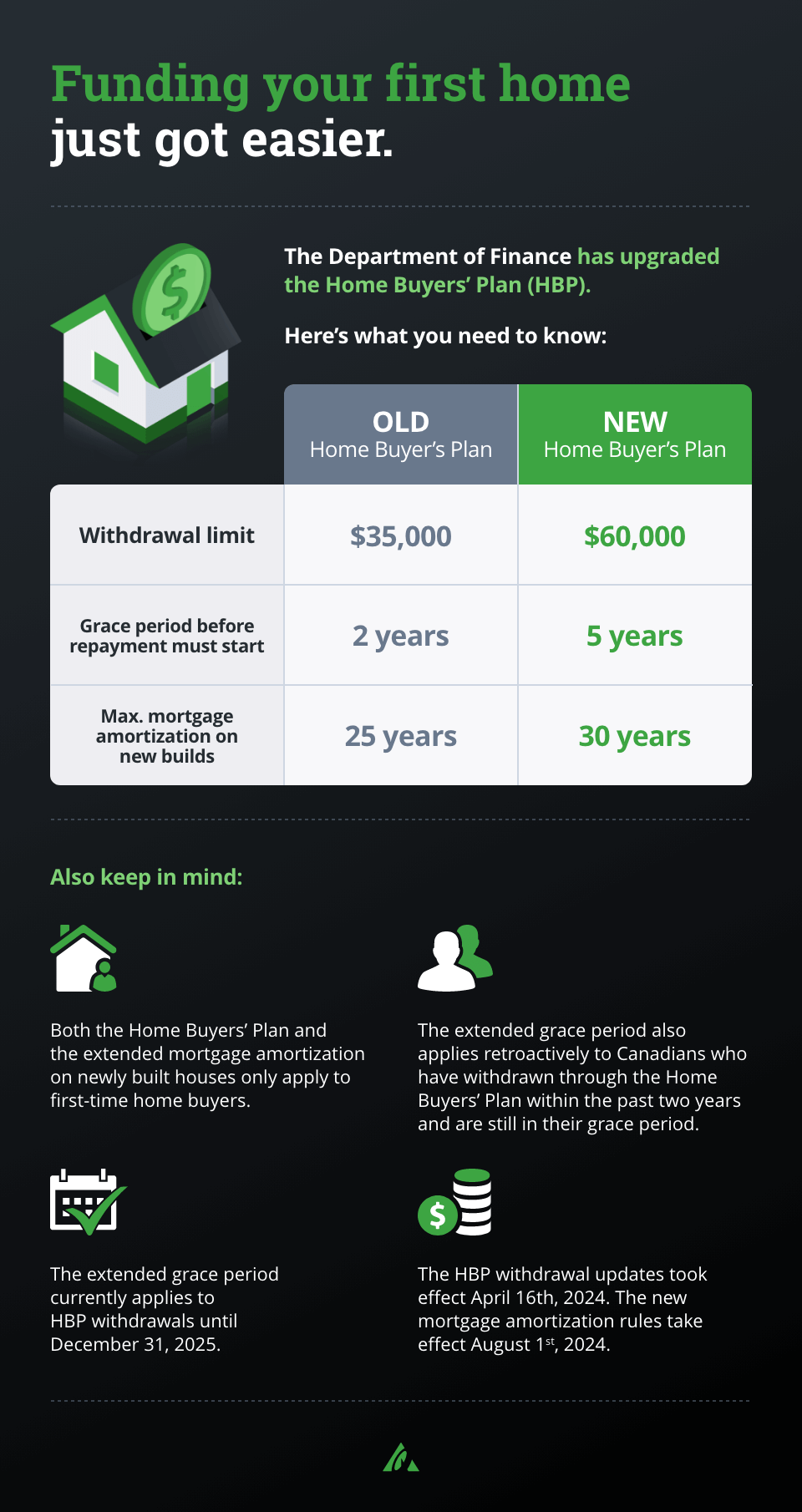
RRSP Home Buyers' Plan withdrawals may be made up to $60,000 per individual, based on limits announced by the Government of Canada in 2024.
First Withdrawal Timing And Grace Period
The first withdrawal can occur in the calendar year of the home purchase or within a January grace period following the closing date, provided eligibility criteria are met.
Minimum Annual Repayment Calculation
Required repayments are generally calculated as one fifteenth of the total funds withdrawn, beginning in the second year after the first withdrawal.
Required Forms
Applicants typically complete CRA Form T1036 along with a financial institution-specific request.
Processing Time And Fees
Processing times and administrative fees may vary by financial institution, based on previously published service standards.
Document Upload Path
Forms and supporting documents are commonly submitted through the financial institution's secure online portal.
What Is the Home Buyers' Plan?
The Home Buyers' Plan can be described as a federal government program that allows eligible home buyers in Canada to access RRSP funds for a home purchase under defined conditions. The program has been administered by the Canada Revenue Agency since the early 1990s and operates within the Income Tax Act. Based on CRA publications, the HBP may be used by individuals who meet first-time home buyer criteria or who qualify under specific life events outlined in prior legislation.
Purpose And General Use
The HBP may help first-time home buyers apply existing retirement savings toward a down payment on a qualifying home that can become a primary residence. Funds withdrawn under the HBP are generally intended for a home purchase in Canada and must relate to a written agreement with a specified closing date. The program has historically allowed participation by individuals, spouses, or common law partners, provided eligibility criteria are met.
Administration And Oversight
The CRA oversees the tax treatment, eligibility criteria, and repayment rules associated with the HBP. Financial institutions, such as brokerages and banks, typically handle the processing of withdrawals and documentation, including required forms.
Comparison With A Taxable RRSP Withdrawal
An HBP withdrawal may differ from a standard RRSP withdrawal in how it interacts with taxable income. Under published rules, qualifying HBP withdrawals may not be included in income tax calculations at the time of withdrawal, provided repayment conditions are followed. In contrast, non-HBP RRSP withdrawals have historically been added to taxable income in the year funds are withdrawn.
HBP Eligibility: Are You a First Time Home Buyer?
Eligibility for the RRSP Home Buyers' Plan has historically been defined by criteria set out by the CRA. Under published rules, an individual may qualify as a first-time home buyer if they did not own and live in a qualifying home during a specified prior period, generally the four calendar years before the year of withdrawal. Eligibility may also extend to individuals who previously owned a home but qualify again due to a breakdown of a marriage or common law partnership, or under provisions related to a disability.
First Time Buyer Definition And Exceptions
The definition of a first-time home buyer has been applied consistently in CRA guidance. In certain cases, individuals with a disability, or those supporting a related person with a disability, may qualify for the HBP even if they do not meet the standard first-time buyer definition.
Contribution Holding Period And Timing
RRSP contributions intended for HBP use generally must have been in the RRSP for a minimum holding period of at least 89 days before funds are withdrawn. Withdrawals may occur in the same calendar year as the home purchase or within a January window following the closing date, provided all other conditions are met.
Who Can Withdraw Funds
Eligible home buyers may withdraw funds from one or multiple RRSPs, including RRSPs held at different financial institutions. Where spousal or common law partner RRSPs are involved, CRA rules have historically applied an overall withdrawal cap per individual, rather than per account.
HBP Limits & Key Dates for Home Buyers
The RRSP Home Buyers' Plan has historically included defined dollar limits and timing rules published by the Canada Revenue Agency. These parameters have been updated periodically through federal budgets and CRA guidance.
Home Buyers' Plan Withdrawal Limits
Eligible home buyers may withdraw up to $60,000 per individual under the HBP. For couples who both meet eligibility criteria, the combined total withdrawn for the same home purchase could reach $120,000. The applicable dollar limit has been tied to the date of the first HBP withdrawal, meaning the limit in effect at that time generally applies to the entire HBP participation for that purchase.
Key Dates And Grace Period
HBP withdrawals may occur in the calendar year in which a qualifying home is acquired or during a grace period extending into January of the following calendar year. The home purchase must be supported by a written agreement with an established closing date, and the property must meet the CRA definition of a qualifying home intended as a primary residence.
Repayment Start Timing
Repayments under the HBP typically begin in the second calendar year following the year of the first withdrawal. The CRA has historically structured the repayment period over up to 15 years, with a minimum annual amount calculated as one fifteenth of the total funds withdrawn.
How To Apply For The Home Buyers' Plan
Application for the RRSP Home Buyers' Plan has historically followed a defined process outlined by the Canada Revenue Agency.
Application Steps
1. Confirm Eligibility
The individual may review CRA eligibility criteria to determine whether they qualify as a first-time home buyer or under an applicable exception, such as disability-related provisions.
2. Ensure RRSP Holding Period
RRSP funds intended for an HBP withdrawal generally must have remained in the account for at least 89 days before the withdrawal date.
3. Enter A Written Purchase Agreement
A written agreement to purchase or build a qualifying home with a stated closing date may be required. The property typically must be intended as a primary residence in Canada.
4. Complete CRA Form T1036
Form T1036, Home Buyers' Plan (HBP) Request to Withdraw Funds from an RRSP, is commonly completed for each withdrawal. Multiple forms may be used if withdrawing from more than one RRSP.
5. Submit Through The Financial Institution
The completed CRA form and any institution-specific documents, such as an HBP request form, are generally submitted to the financial institution holding the RRSP.
6. Receive Funds
Once processed, funds withdrawn under the HBP may be issued directly to the individual, often by deposit or cheque, depending on institutional practices.
7. Track HBP Balance
The CRA typically tracks the HBP balance and repayment requirements through annual income tax filings.
Processing timelines, document submission methods, and administrative fees may vary by financial institution.
Processing Times, Methods & Fees
Processing under the RRSP Home Buyers' Plan has historically varied by financial institution, based on previously published service standards and CRA guidance.
Typical Processing Timelines
Review Period
Financial institutions may take approximately one to two business days to review submitted HBP forms and supporting documents.
Funding Timing By Method
Once approved, funding timelines may differ depending on the delivery method selected, such as electronic funds transfer (EFT), cheque, or wire transfer.
Withdrawal Methods
EFT Or Cheque
EFT or cheque has commonly been offered by many institutions for HBP withdrawals.
Wire Transfers
Some institutions have previously limited or declined wire transfers for HBP withdrawals. Availability has varied over time, and confirmation with the institution has typically been required.
Fees And Tax Treatment
Withholding Tax
Based on CRA rules, withholding tax has generally not applied to HBP withdrawals that fall within the permitted limit.
Common Causes Of Delays
- Incomplete or unsigned CRA Form T1036
- RRSP contributions not meeting the minimum holding period
- Missing or unclear purchase documentation
Reviewing forms carefully before submission can reduce the likelihood of processing delays.
Repayment Rules for the Home Buyers' Plan
Repayment under the RRSP HBP has historically followed parameters published by the CRA. These rules describe how funds withdrawn may be repaid to an RRSP over time and how amounts are reported through annual income tax filings.
Repayment Period And Calculation
Length Of Repayment
The HBP repayment period has been structured over up to 15 years, beginning in the second calendar year after the first withdrawal.
Minimum Annual Amount
The minimum annual repayment has generally been calculated as one fifteenth of the total funds withdrawn under the HBP. This amount has remained consistent across the repayment period unless additional withdrawals occurred.
Reporting Repayments
Repayments have typically been designated on the individual's annual income tax return, using Schedule 7. Amounts reported as HBP repayments may be treated differently from regular RRSP contributions for tax purposes, based on CRA guidance.
Missed Or Partial Repayments
If the minimum required repayment for a given year has not been designated, the unpaid portion may be added to taxable income for that year. Once included in income, that amount has not historically been eligible for future HBP repayment treatment.
Examples
| Withdrawal Amount | Repayment Start Year | Minimum Annual Repayment | Missed Year Outcome |
|---|---|---|---|
| $30,000 | Second year after withdrawal | $2,000 per year | $2,000 may be added to taxable income |
| $45,000 | Second year after withdrawal | $3,000 per year | $3,000 may be included in income |
| $60,000 | Second year after withdrawal | $4,000 per year | $4,000 may increase taxable income |
HBP vs FHSA: A Closer Look
The RRSP Home Buyers' Plan (HBP) and the First Home Savings Account (FHSA) have both been introduced through federal legislation to support first-time home buyers. Each program has operated under distinct rules published by the CRA.
Program Comparison
| Feature | HBP (RRSP Home Buyers' Plan) | FHSA (First Home Savings Account) |
|---|---|---|
| Maximum Amount | Up to $60,000 per individual (2026 limit) | Lifetime contribution limit of $40,000 |
| Tax Treatment | Withdrawals may not be included in taxable income if conditions are met | Qualifying withdrawals may be tax free |
| Repayment Required | Yes, generally over up to 15 years | No repayment required |
| Eligible Users | First-time home buyers meeting CRA criteria | First-time home buyers who open an FHSA |
| Flexibility | Linked to RRSP rules and repayment schedule | Separate account with annual contribution limits |
Combining The Programs
CRA guidance has indicated that the HBP and FHSA may be used together for the same qualifying home purchase, provided the eligibility criteria for each program are met. In such cases, funds from both programs may be applied toward a down payment without affecting each other's limits.
First Time Home Buyer Example
A couple who both qualify as first-time home buyers may participate individually in each program. Based on published limits, each individual could withdraw up to $60,000 under the HBP, for a combined total of $120,000. If both individuals have also accumulated FHSA savings, additional qualifying FHSA withdrawals may be applied to the same purchase. The HBP portion would generally be subject to future repayment requirements, while FHSA withdrawals would not.
Final Notes on the Canada Revenue Agency's Home Buyers' Plan
The RRSP Home Buyers' Plan (HBP) has historically offered first-time home buyers in Canada access to retirement savings for a down payment while providing structured repayment rules and tax treatment.
When combined with programs like the First Home Savings Account, it may support a larger home purchase under clearly defined limits. Participation generally involves verifying eligibility, completing CRA Form T1036, coordinating with a financial institution, and adhering to the repayment schedule over up to 15 years.
Understanding key rules, deadlines, and reporting requirements may help buyers manage withdrawals and repayments according to CRA guidance.