Multi-leg options trading
Published: Oct 17, 2022
Updated: Apr 30, 2025
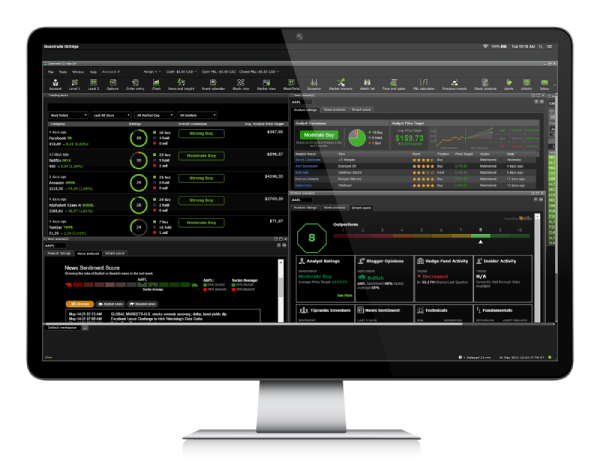
Simplify complex options and take your trading to the next level with Questrade’s Edge platforms.
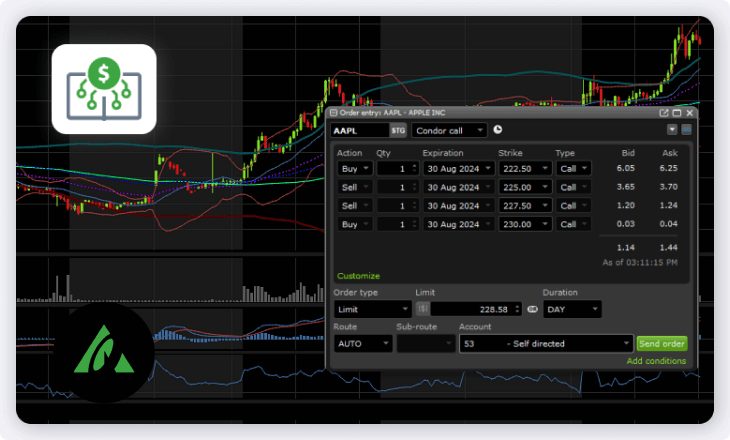
Whether you’re aiming to maximize profits or minimize risks, multi-leg options trading can help unlock more strategies with additional precision and order flexibility.
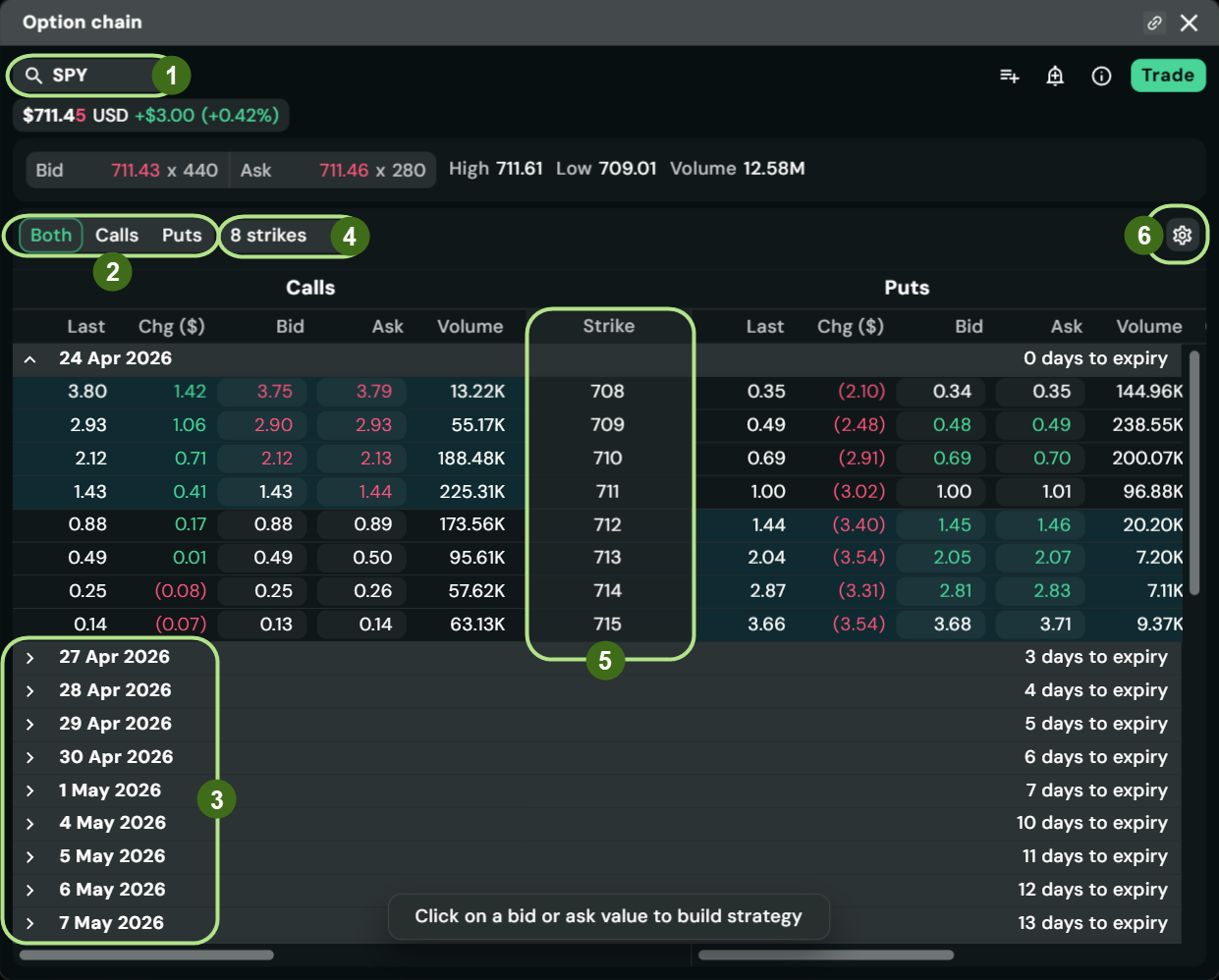
At Questrade, we’re proud to offer multi-leg options trading with both pre-built and fully custom strategies in our suite of Questrade Edge platforms.
What is multi-leg options trading?
Some trading strategies involve buying multiple securities, sometimes of different types, at the same time. There’s a number of reasons to do this, such as limiting the risk exposure of an options play, increasing potential profitability, ‘rolling’ a contract to a new expiration/strike, or even purchasing shares to cover short option contract obligations.
Multi-leg orders allow you to enter multiple buy & sell orders at the same time instead of having to place them one by one separately.
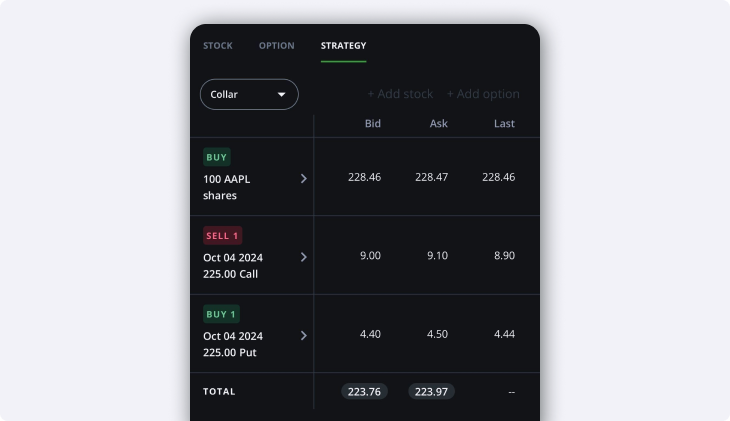
Advantages of multi-leg trading
More convenient: Place trades for an entire strategy with a single click or tap
More consistent: Execute multi-leg trades simultaneously
Helps reduce the risk of execution delays
Ensures that every part of your trade aligns perfectly
Flexible: Tailor your custom or pre-built strategies to specific market conditions
Lower margin requirements: Compared to placing & maintaining individual positions, multi-leg strategies can take advantage of lower margin requirements since the risk/reward profile is more defined
Common multi-leg options strategies
Multi-leg options strategies can be a powerful tool for traders looking to optimize their portfolios, and expand their trading beyond stocks and ETFs. These strategies come in many different shapes and sizes, with varying levels of risk and complexity.
In this article we'll discuss some of the most popular multi-leg strategies, starting with the foundational covered call. Covered calls can help build a foundation for more advanced multi-leg trading and are often the first strategy used by many traders looking to get further into options.
Covered Calls: The starting point for multi-leg trading
The covered call is one of the most straightforward and widely used multi-leg options strategies, especially among more conservative, income-oriented investors.
This strategy involves holding a long position in a stock/ETF (owning the shares) and then selling a call option on that same stock or ETF. The primary goal here is to generate income from the premium received for selling the call option, while also having the potential to benefit from any appreciation in the stock’s price, up to the strike price of the call option.
Learn more about covered calls.
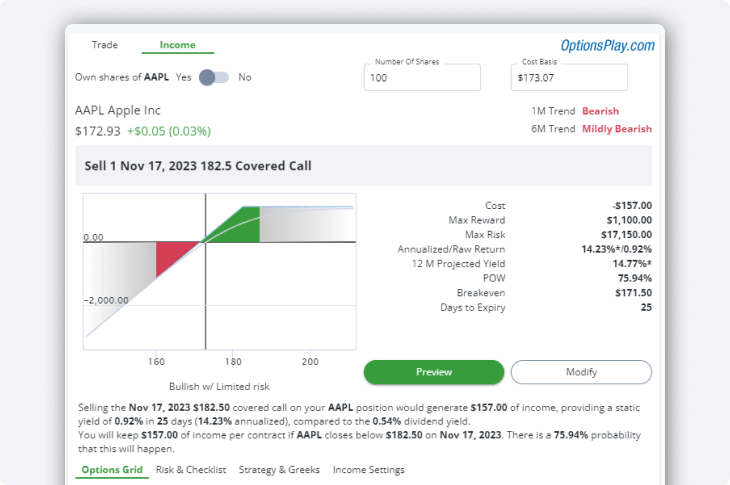
Securities shown are for illustrative, educational, and visual purposes only, and should not be relied upon as financial advice. The information provided is not intended to be and should not be construed as a recommendation, offer, or solicitation to buy or sell.
Tip: With tools like OptionsPlay, which are built right into Questrade Edge Web and Desktop, you can easily identify covered call opportunities and fine-tune your strike prices and expiration dates for maximum profit potential—all while aligning with your personal risk tolerances.
The Income Tab in OptionsPlay (shown above) makes it simple to see how much income you could generate from covered calls or cash-secured puts.
Straddles: Capitalizing on volatility without picking a side
A long straddle involves buying both a call and a put option on the same underlying asset, with the same strike price and expiration date. The beauty of the long straddle lies in its ability to profit from significant price movements in either direction—whether the market goes up or down, you stand to profit as long as the price movements are substantial.
Strangles: A flexible approach to volatility with a directional bias
Similar to a straddle, a long strangle also involves buying both a call and a put option. However, in a strangle, the call and put options have different strike prices, typically with the call option having a higher strike price than the put.
This setup allows you to be more flexible and manage costs while still positioning for significant market movements and volatility.
Customize your strategy: With OptionsPlay’s Trading Tab, you can preview a range of bullish or bearish strategies, including strangles, straddles and more.
Spreads: Balancing risk and reward
Spreads are a category of multi-leg strategies that involve buying and selling options of the same type (calls or puts) but with different strike prices and/or expiration dates. Spreads come in several varieties, each serving a specific trading purpose:
Vertical spreads: This strategy involves buying and selling options with the same expiration date but different strike prices. Vertical spreads are useful for limiting both potential profits and losses, making them a good choice for traders looking to balance risk and reward.
Horizontal (Calendar) spreads: Involves buying and selling options with the same strike price but different expiration dates. Horizontal spreads are often used to take advantage of time decay in options pricing, tying profits to the difference in the decay rates of the short-term and long-term options.
Diagonal spreads: Diagonal spreads combine elements of both vertical and horizontal spreads, involving options with different strike prices and different expiration dates. This strategy provides a higher degree of customization, allowing traders to tailor their risk and reward profiles to their market outlook.


Stuck remembering which spread is which?
Tip: Tools like the Plain English Tab in OptionsPlay break down complex strategies like spreads into easy-to-understand explanations. You can also use the P&L Simulator and Risk Calculator to ensure the strategy aligns with your personal risk tolerance.
With the multitude of option strategies available, it’s easy to get lost in the details. By understanding how they are named you can quickly identify their characteristics:
Vertical Spread: Focuses on the "vertical" price difference between different strike prices but the same expiration date. Picture the vertical axis on a graph representing price.
Horizontal (Calendar) spreads: Involves options with the same strike price but different expiration dates. Imagine the "horizontal" axis on a graph, which represents time.
Diagonal Spread: Combines both vertical and horizontal elements, with options that have different strike prices and expiration dates. Picture a line running diagonally on a graph, covering both price and time differences.
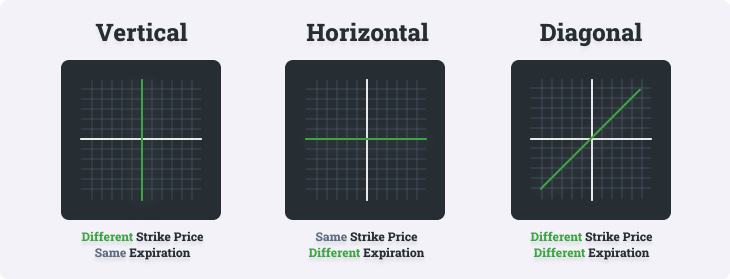
By visualizing these spreads as lines on a graph, you can easily remember their key differences.
Butterflies and Condors: Complex strategies for range-bound markets
Butterflies and condors are multi-leg strategies that involve many options contracts to create a defined risk/reward profile, making them ideal for traders who expect limited price movement within a specific range.
Butterfly Spread: This strategy involves buying one option at a lower strike price, selling two options at a middle (usually at-the-money) strike price, and buying another option at a higher strike price (all with the same expiration date), for a total of four option contracts being bought & sold at the same time.
Butterfly spreads profit the most when the underlying asset’s price remains close to the middle strike price at expiration, and doesn’t move significantly in either direction.
Iron Condor: An iron condor is an extension of the butterfly spread, involving four options with different strike prices, but the same expiration date.
The strategy combines two vertical spreads: a bull put spread and a bear call spread. The iron condor profits when the underlying asset stays within a defined price range, making it a favored strategy in low-volatility markets.

These strategies are just the tip of the iceberg in the world of options trading. By mastering these multi-leg approaches, you can gain greater control over your trades, tailor your risk/reward profiles, and navigate the complexities of the options market with confidence.
Whether you’re just starting with covered calls or diving into more advanced strategies like iron condors, there’s a multi-leg approach that can help you achieve your trading goals.
Important to know
As you dive into the world of multi-leg options trading, here are a few key considerations to keep in mind:
Understand the complexity: Multi-leg strategies range from simple (covered calls) to complex (iron condors). Use tools like OptionsPlay and P&L calculators to break down and simulate strategies.
Monitor your positions: Keep a close eye on volatility (IV), time decay (theta), and market movements to adjust your trades as needed.
Leverage margin wisely: Take advantage of potentially lower margin requirements, but avoid over-leveraging your positions and potentially ending up in a margin call.
Stay educated and informed: Continuously learn and stay updated on market trends, economic indicators, and new tools.
Tip: Resources like OptionsPlay offer daily trade ideas and educational resources.
Looking for more research? Explore tools from TipRanks and Seeking Alpha for an even greater trading edge.
Use the right tools: Simplify your trading process with OptionsPlay in Questrade’s Edge platforms—research tools, trade ideas, and profit calculators are all available for free to help you make informed decisions.
Remember to enable options trading: If you haven’t traded options before, you may need to enable them for your account.
Note: Registered and Cash accounts can only trade up to level 2 option strategies. Level 3 and 4 strategies require a Margin account.
Start trading smarter today
Trade with confidence using powerful, free tools tailored to your success. Unlock the full potential of options trading with Questrade.
Note: Transactions in options can carry a high degree of risk, and may not be suitable for investors with a limited risk profile. Purchasers and sellers of options should familiarize themselves with the type of option (i.e. put or call they contemplate trading and the associated risks.
Please be advised that the strategies discussed above are for informational and educational purposes only and do not constitute financial advice. They may not be suitable for all investors depending on your personal risk tolerance, and familiarity with options contracts.
This article does not disclose all of the risks and other significant aspects of trading in options. In light of the risks, you should undertake such transactions only if you understand the nature of the contracts (and contractual relationships) into which you are entering and the extent of your exposure to risk.
You should carefully consider whether trading options is appropriate for you in light of your experience, objectives, financial resources and other relevant circumstances. For more information, please refer to our complete Options Risk disclosure.